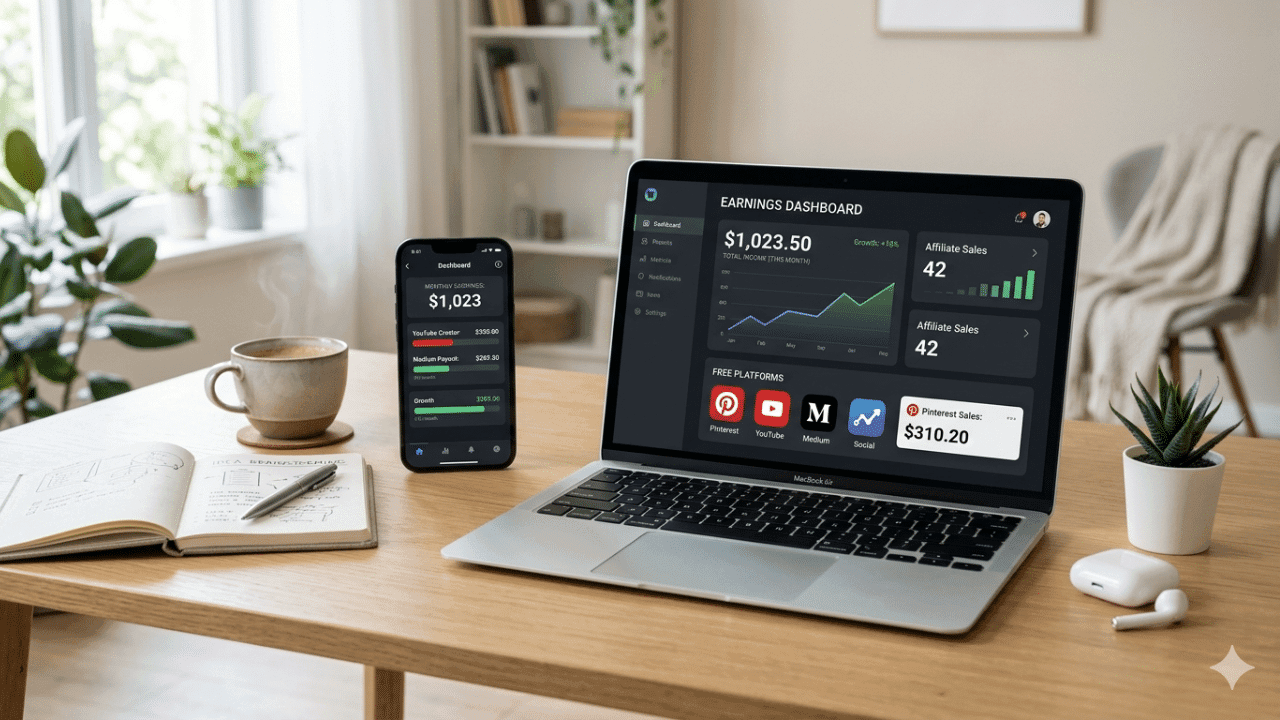
You don’t need a million YouTube subscribers. You don’t need a verified Instagram account. You don’t even need a professional camera or a studio setup. In 2026, there are free platforms that genuinely pay content creators, and many of them will start sharing revenue with you from your very first piece of content, long before you’ve built any kind of following.
This guide breaks down 8 of those platforms. For each one, you’ll see exactly what kind of content performs best, what the payment structure looks like, and whether it’s genuinely beginner-accessible or just pretending to be.
No hype. Just real platforms, real payment models, and honest assessments of what it actually takes to earn on each one
Why Most People Miss These Platforms
The creator economy gets talked about constantly in terms of YouTube and Instagram. But those platforms are genuinely hard to monetize as a beginner. YouTube requires 1,000 subscribers and 4,000 watch hours before you see a cent. Instagram has no direct creator payment at all.
Meanwhile, smaller and newer platforms are actively trying to attract creators. They need content to grow. So they pay for it, sometimes immediately, sometimes with very low thresholds, and sometimes with no follower requirement whatsoever.
If you’ve been waiting until you’re “big enough” to start earning from content, these platforms eliminate that excuse.
1. Medium Partner Program
Best for: Writers and bloggers
Payment model: Reader engagement earnings (time spent reading your content)
Minimum payout: $10
Follower requirement: None
Signup cost: Free to write, $5/month to join the Partner Program as a reader
Medium pays writers based on how much time paying Medium members spend reading their articles. You don’t need followers to start. If your article gets curated by Medium’s editorial team and distributed across the platform, it can earn from day one.
What Works Best on Medium
Personal experience stories with practical takeaways
How-to guides with specific actionable steps
Opinion pieces on trending topics in business, technology, and self-improvement
Realistic Earnings
Beginners with strong writing typically earn $5 to $50 per article in the first few months. Top Medium writers earn $1,000 to $5,000+ per month. The gap is skill, consistency, and understanding what Medium’s algorithm rewards.
Tip
Submit your articles to relevant Medium publications for dramatically higher distribution and earnings.
2. Substack
Best for: Writers who want a newsletter audience.
Payment model: Subscription revenue (readers pay monthly/yearly for your content.)
Minimum payout: $0.50
Follower requirement: None.
Sign-up cost: Completely free.
Substack takes 10% of paid subscriptions.
Substack lets you send email newsletters and charge subscribers a monthly fee for premium content. The free tier lets you build an audience without any upfront cost, and you can add paid subscriptions whenever you’re ready.
What Works Best on Substack
Niche newsletters (specific topics for specific audiences)
Behind-the-scenes or exclusive insights in your area of knowledge
Weekly roundups with personal commentary
Realistic Earnings
Even a small paid list of 100 subscribers at $7/month generates $700/month. The key is building trust with free content first, then converting a percentage of readers to paid subscribers.
Tip
Substack’s internal discovery feature actively promotes growing newsletters to new readers, a genuine built-in growth mechanism most people don’t use.

3. YouTube (with Shorts Monetization)
Best for: Video creators who can produce short-form content.
Payment model: Ad revenue share + Shorts bonus fund.
Minimum payout: $100 via AdSense
Follower requirement: 500 subscribers + 3,000 watch hours for standard monetization
Yes, standard YouTube monetization has thresholds. But YouTube Shorts now offers a separate monetization path that many beginners reach significantly faster than the standard requirements.
What Works Best as a Beginner
Shorts under 60 seconds on specific how-to topics
Reaction or commentary content in a specific niche
Educational “did you know” style content
Realistic Earnings
YouTube Shorts creators earn between $0.03 and $0.07 per 1,000 views on average. At 100,000 views, that’s $3 to $7. It sounds small, but viral Shorts happen quickly and stack.
Tip
Use YouTube as a long-term play. The channel you build now keeps earning for years.
4. TikTok Creator Rewards Program
Best for: Short-form video creators
Payment model: Per-view earnings based on engagement
Minimum payout: $50
Follower requirement: 10,000 followers + 100,000 views in the last 30 days
TikTok’s Creator Rewards Program pays significantly more than the old Creator Fund. The follower requirement means it’s not instant, but 10,000 TikTok followers is far more achievable than it sounds with consistent posting.
What Works Best on TikTok
Educational content under 60 seconds
Day-in-the-life or behind-the-scenes content
Trending audio with original commentary
Realistic Earnings
Creators with 50,000 to 100,000 followers typically earn $200 to $1,000 per month from the Creator Rewards Program alone, before brand deals or affiliate income.
Tip
Post 3 to 5 times a week minimum. Consistency matters more than production quality on TikTok.
5. Vocal Media
Best for: Writers across all niches
Payment model: Pay-per-read (earnings per 1,000 reads)
Minimum payout: $35
Follower requirement: None
Sign-up cost: Free
Vocal Media pays writers per read, meaning every person who reads your article earns you money.
What Works Best on Vocal
Top 10 lists and listicle-style articles
True crime and mystery stories
Personal experience essays
Food and travel content
Realistic Earnings
Vocal is best treated as a supplemental income source rather than a primary one. Writers who publish consistently across multiple niches can earn $50 to $200 per month without a massive audience.
Tip
Vocal runs regular writing challenges with cash prizes. Entering these competitions is one of the fastest ways to earn above the per-read rate.
6. Newsbreak
Best for: Local news and community writers
Payment model: Advertising revenue share per article
Minimum payout: $100
Follower requirement: None
Sign-up cost: Free
Newsbreak is a local news platform that pays writers to cover community topics such as local events, neighborhood news, and regional stories.
What Works Best on Newsbreak
Local event coverage
Community interest stories
Regional news commentary
City-specific guides and recommendations
Realistic Earnings
Newsbreak reporters typically earn $50 to $500 per month depending on consistency, local relevance, and audience engagement.
Tip
If you write about your own city or community, you have an immediate advantage over creators writing generic national content.
7. Amazon Kindle Direct Publishing (KDP)
Best for: Writers who can produce longer-form content
Payment model: Royalties per sale (35% or 70% depending on price)
Minimum payout: $100
Follower requirement: None
Sign-up cost: Completely free to publish
Amazon KDP lets anyone publish eBooks and paperbacks and sell them directly on Amazon.
What Works Best on KDP
Short how-to guides (5,000 to 15,000 words)
Niche topic deep-dives
Workbooks, journals, and planners
Beginner guides in specific subjects
Realistic Earnings
A single well-targeted eBook at $4.99 with 70% royalties earns approximately $3.49 per sale. Sell 100 copies a month, and you’re earning roughly $349 passively.
Tip
The fastest path to KDP income is publishing multiple short books in the same niche rather than one long book.
8. Gumroad
Best for: Creators selling digital products
Payment model: You keep 90%+ of each sale
Minimum payout: $10
Follower requirement: None
Sign-up cost: Completely free to start
Gumroad isn’t technically a platform that pays you to create. It’s a platform that lets you sell what you create with zero upfront cost.
What Sells Well on Gumroad
Digital templates (Canva, Notion, Excel)
Short eBooks and guides
Preset packs for photographers and video editors
Online courses and workshop recordings
Stock photos and digital art
Realistic Earnings
One well-designed Canva template pack at $15 sold to 50 people earns $750.
Tip
Use the “Pay What You Want” pricing option for your first product to lower the barrier to entry and get testimonials faster.
Which Platform Should You Start With?
The right platform depends on what you create:
Articles and blog-style writing: Medium or Vocal
Email newsletters: Substack
Short videos: TikTok or YouTube Shorts
Local and community stories: Newsbreak
Digital products and templates: Gumroad
eBooks and guides: Amazon KDP
The most important rule:
Start with ONE platform. Not three. Not five. One. Get comfortable, build your first income stream, then add a second platform once the first is running.
The Mistake That Keeps Most Creators Broke
Spreading yourself across every platform before mastering any of them.
This is by far the most common reason content creators earn nothing despite working hard.
Pick the platform that matches your strongest content type. Publish consistently for 60 days before judging the results. Adjust based on what’s actually working, not what looks most exciting in a YouTube thumbnail about passive income.
The platforms on this list are real. The income is real. But none of it shows up in week one without effort and consistency.
Start today. Publish your first piece within 48 hours. The rest builds from there.
Final Thoughts
The internet has created more opportunities than ever for creators to earn money without a large audience. Whether you’re a writer, video creator, newsletter publisher, or digital product seller, there’s a platform that can help you start generating income today.
Choose one platform, stay consistent, and focus on improving your content. Small results compound over time, and many successful creators started with zero followers and a single piece of content.
Found this guide useful? Save it for later and share it with a friend who’s been thinking about creating content but hasn’t started yet.

Muse is the founder of MusabGuide, covering online business, digital marketing, and AI tools. He creates practical guides and honest reviews to help beginners and entrepreneurs make informed decisions online.
1 thought on “8 Free Platforms That Pay You to Create Content in 2026”