How to Start Investing With $100 in 2026 (A Beginner’s Step-by-Step Guide)
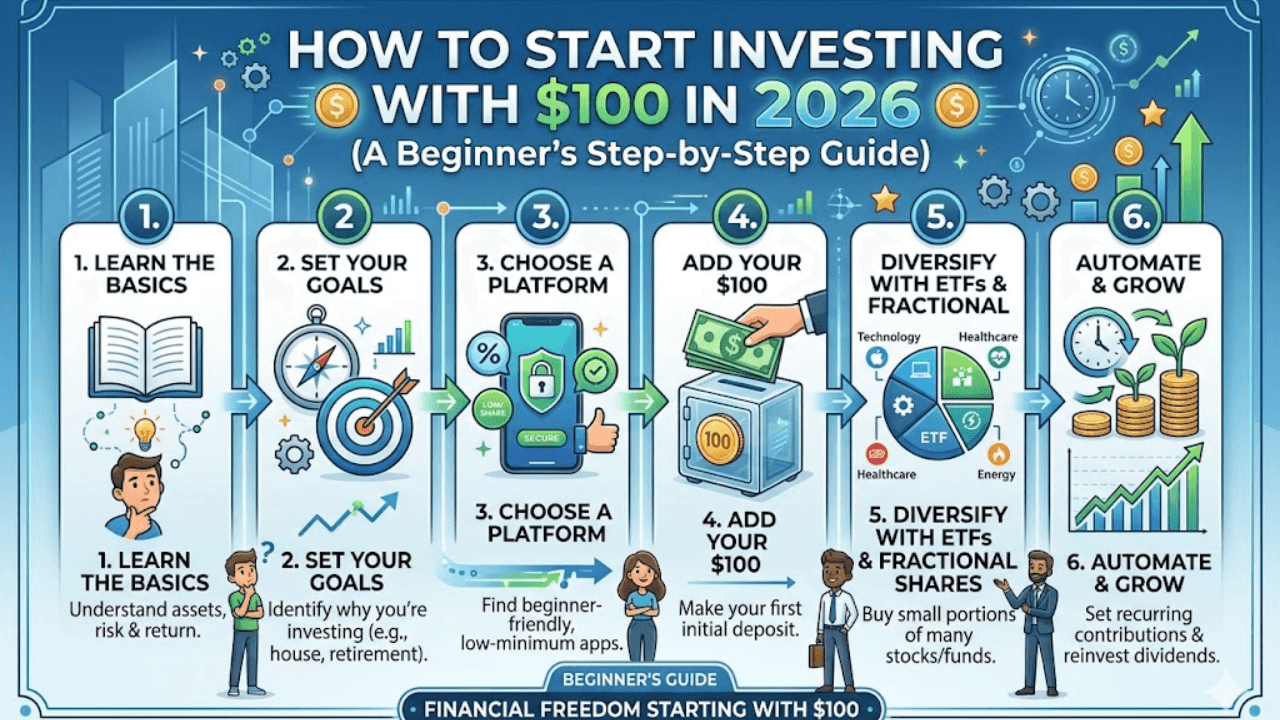
One hundred dollars invested today at a seven percent average annual return grows to over $760 in 30 years. That’s without adding a single extra dollar. Imagine what happens when you make it a monthly habit. The biggest myth in personal finance is that you need thousands of dollars before investing makes sense. Every major brokerage in 2026 offers fractional shares — meaning you can buy a piece of Amazon, Apple, or an S&P 500 index fund for as little as $1. The barrier to entry has never been lower. This guide is written for complete beginners. If you’ve never invested a dollar in your life, you’re in the right place. By the time you finish reading, you’ll know exactly which account to open, what to buy with your first $100, and how to turn that small start into a genuine wealth-building habit. No jargon. No fluff. Just a clear, honest roadmap. Why Starting With $100 Makes More Sense Than Waiting Most people who haven’t started investing aren’t waiting because they don’t have enough money. They’re waiting because they believe the story that they don’t have enough money. The truth is that learning how to start investing with $100 right now does more for your financial future than waiting until you have $1,000 in five years. There are two reasons for this. First, compound interest is time-dependent. The longer your money is invested, the more it compounds — and compounding is exponential, not linear. Every year you delay means a smaller final number, no matter how much you put in later. Second, starting builds the habit. Beginning with $100 teaches you the mechanics of investing, builds your confidence, and establishes a routine that scales as your income grows. That behavioral shift — from someone who thinks about investing to someone who actually does it — is worth more than any particular investment choice you make. The biggest mistake isn’t starting small. It’s not starting at all. Step 1 — Check Your Financial Foundation First Before you invest a single dollar, take a quick look at your current financial situation. This isn’t about being perfect — it’s about making sure investing is the right next move. Do you have a basic emergency fund? You need one to three months of expenses saved in a high-yield savings account before investing in stocks. If an emergency hits and you’re forced to sell investments early, you might be selling at a loss. Protect your investments by having cash available for unexpected expenses first. Do you have high-interest debt? Credit card debt at 20–25% interest is a guaranteed negative return. Paying that off first is effectively a 20–25% risk-free return on your money — better than the stock market’s historical average. Pay off high-interest debt before investing in stocks. Low-interest debt like student loans or mortgages below 6% is generally fine to carry while investing simultaneously. If you have a small emergency fund and no high-interest debt, you’re ready to invest. If you don’t quite have those covered, put $50 toward your emergency fund and invest the other $50. Progress beats perfection. Step 2 — Choose the Right Investment Account Before choosing investments, decide which type of account to open. This decision matters more than which specific stocks or funds you choose, because the tax treatment of your account affects how much wealth you actually keep over time. Roth IRA — Best Choice for Most Beginners A Roth IRA is a retirement account with a powerful tax advantage. You invest after-tax dollars, and everything that grows inside the account is completely tax-free when you withdraw in retirement. Regular Brokerage Account — Best for Non-Retirement Goals If you’re investing for goals other than retirement — a house deposit, a car, a travel fund — a standard taxable brokerage account gives you the flexibility to withdraw money anytime without penalties. 401(k) — Get Your Employer Match First If your employer offers a 401(k) match, contribute enough to get the full match before anything else. A 50% or 100% match on your contributions is an instant, guaranteed return that beats every other investment option available. The simple priority order: Get your full employer 401(k) match → Open a Roth IRA with your $100 → Open a taxable brokerage account once tax-advantaged accounts are maxed out. Step 3 — Pick the Best Platform for Beginners In 2026, most online brokers require no minimum deposit to open an account, charge zero commissions on stock and ETF trades, and offer fractional shares. You can get started with $100 on any of the major platforms. Here’s a straightforward comparison: Fidelity — Best Overall Fidelity is the strongest all-around choice for new investors in 2026. Charles Schwab — Best for Long-Term Investors Robinhood — Best for Simplicity For most beginners, Fidelity is the recommendation. The combination of zero-expense-ratio index funds, fractional shares, strong educational resources, and no account minimums makes it the strongest starting point in 2026. Step 4 — Decide What to Buy With Your $100 This is the part most beginners overthink. Let’s make it simple. Index funds and ETFs are the most recommended option for beginners because they provide instant diversification. A single share of a total stock market ETF gives you exposure to thousands of companies at once. You don’t need to pick individual stocks. You don’t need to research companies. You don’t need to watch financial news. Option 1 — Total Stock Market ETF (Best Overall Choice) A total market ETF puts your money into essentially the entire US stock market in one purchase. When the US economy grows, your investment grows with it. Top picks: With $100, you can buy fractional shares of either of these immediately. Option 2 — S&P 500 Index Fund (Most Popular) An S&P 500 fund tracks the 500 largest publicly traded US companies. It’s the benchmark that most professional fund managers fail to beat over the long term. Top picks: The S&P 500 has historically returned approximately 10% annually before inflation … Read more