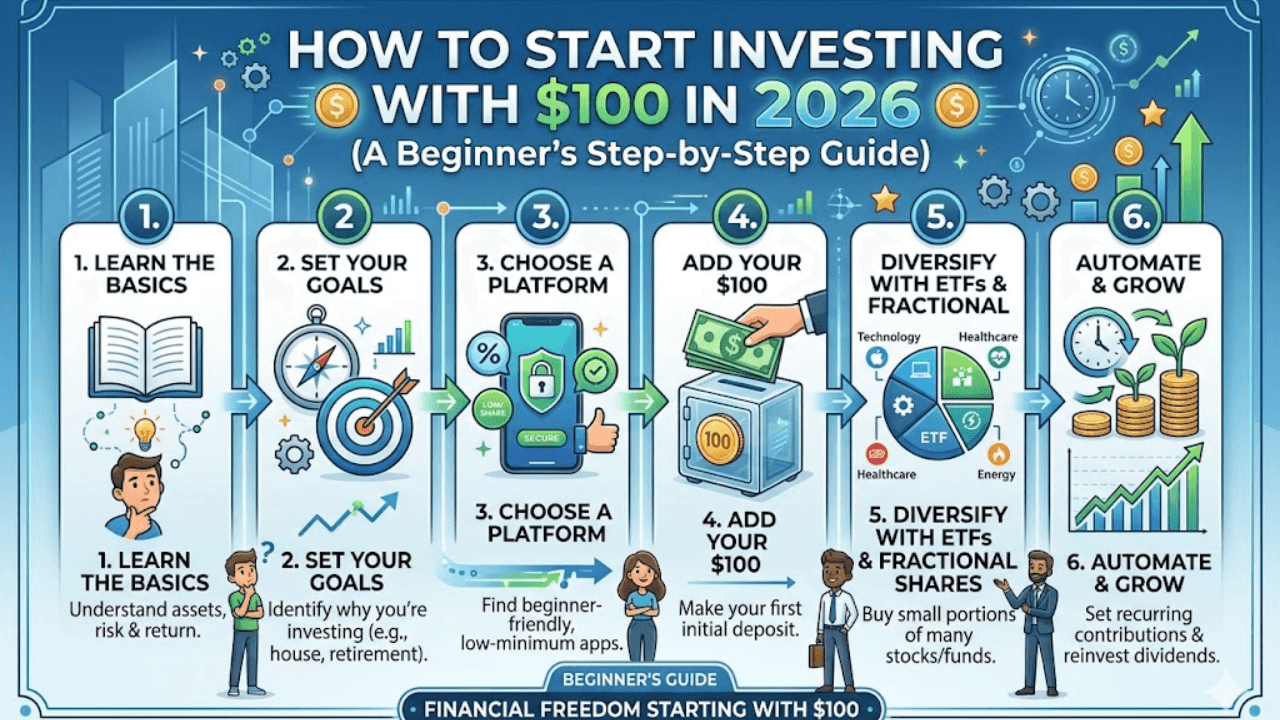
One hundred dollars invested today at a seven percent average annual return grows to over $760 in 30 years. That’s without adding a single extra dollar. Imagine what happens when you make it a monthly habit.
The biggest myth in personal finance is that you need thousands of dollars before investing makes sense. Every major brokerage in 2026 offers fractional shares — meaning you can buy a piece of Amazon, Apple, or an S&P 500 index fund for as little as $1. The barrier to entry has never been lower.
This guide is written for complete beginners. If you’ve never invested a dollar in your life, you’re in the right place. By the time you finish reading, you’ll know exactly which account to open, what to buy with your first $100, and how to turn that small start into a genuine wealth-building habit.
No jargon. No fluff. Just a clear, honest roadmap.
Why Starting With $100 Makes More Sense Than Waiting
Most people who haven’t started investing aren’t waiting because they don’t have enough money. They’re waiting because they believe the story that they don’t have enough money.
The truth is that learning how to start investing with $100 right now does more for your financial future than waiting until you have $1,000 in five years. There are two reasons for this.
First, compound interest is time-dependent. The longer your money is invested, the more it compounds — and compounding is exponential, not linear. Every year you delay means a smaller final number, no matter how much you put in later.
Second, starting builds the habit. Beginning with $100 teaches you the mechanics of investing, builds your confidence, and establishes a routine that scales as your income grows. That behavioral shift — from someone who thinks about investing to someone who actually does it — is worth more than any particular investment choice you make.
The biggest mistake isn’t starting small. It’s not starting at all.
Step 1 — Check Your Financial Foundation First
Before you invest a single dollar, take a quick look at your current financial situation. This isn’t about being perfect — it’s about making sure investing is the right next move.
Do you have a basic emergency fund?
You need one to three months of expenses saved in a high-yield savings account before investing in stocks. If an emergency hits and you’re forced to sell investments early, you might be selling at a loss. Protect your investments by having cash available for unexpected expenses first.
Do you have high-interest debt?
Credit card debt at 20–25% interest is a guaranteed negative return. Paying that off first is effectively a 20–25% risk-free return on your money — better than the stock market’s historical average. Pay off high-interest debt before investing in stocks. Low-interest debt like student loans or mortgages below 6% is generally fine to carry while investing simultaneously.
If you have a small emergency fund and no high-interest debt, you’re ready to invest. If you don’t quite have those covered, put $50 toward your emergency fund and invest the other $50. Progress beats perfection.
Step 2 — Choose the Right Investment Account
Before choosing investments, decide which type of account to open. This decision matters more than which specific stocks or funds you choose, because the tax treatment of your account affects how much wealth you actually keep over time.
Roth IRA — Best Choice for Most Beginners
A Roth IRA is a retirement account with a powerful tax advantage. You invest after-tax dollars, and everything that grows inside the account is completely tax-free when you withdraw in retirement.
- 2026 contribution limit: $7,000 per year ($8,000 if you’re 50 or older)
- Zero taxes on growth or withdrawals in retirement
- You can withdraw your contributions — not earnings — penalty-free if needed.
- Income limits apply — check IRS guidelines if you earn over $150,000 per year as a single filer
Regular Brokerage Account — Best for Non-Retirement Goals
If you’re investing for goals other than retirement — a house deposit, a car, a travel fund — a standard taxable brokerage account gives you the flexibility to withdraw money anytime without penalties.
- No contribution limits
- No tax advantages, but no penalties for early withdrawal either
- Best for goals with a three to ten year timeline
401(k) — Get Your Employer Match First
If your employer offers a 401(k) match, contribute enough to get the full match before anything else. A 50% or 100% match on your contributions is an instant, guaranteed return that beats every other investment option available.
The simple priority order: Get your full employer 401(k) match → Open a Roth IRA with your $100 → Open a taxable brokerage account once tax-advantaged accounts are maxed out.

Step 3 — Pick the Best Platform for Beginners
In 2026, most online brokers require no minimum deposit to open an account, charge zero commissions on stock and ETF trades, and offer fractional shares. You can get started with $100 on any of the major platforms.
Here’s a straightforward comparison:
Fidelity — Best Overall
Fidelity is the strongest all-around choice for new investors in 2026.
- $0 minimum to open an account
- $0 commissions on stock and ETF trades
- Fractional shares available from $1
- The Fidelity ZERO Total Market Index Fund carries a 0.00% expense ratio — literally free to hold
- Excellent educational resources and customer support available
Charles Schwab — Best for Long-Term Investors
- $0 minimum, $0 commissions on stocks and ETFs
- Fractional shares available
- A wide range of investment options
- Strong research tools for when you’re ready to go deeper
Robinhood — Best for Simplicity
- $0 minimum, $0 commissions
- Clean, beginner-friendly mobile app
- Fractional shares from $1
- SIPC-insured up to $500,000 if the broker fails
- Less educational content than Fidelity or Schwab
For most beginners, Fidelity is the recommendation. The combination of zero-expense-ratio index funds, fractional shares, strong educational resources, and no account minimums makes it the strongest starting point in 2026.
Step 4 — Decide What to Buy With Your $100
This is the part most beginners overthink. Let’s make it simple.
Index funds and ETFs are the most recommended option for beginners because they provide instant diversification. A single share of a total stock market ETF gives you exposure to thousands of companies at once. You don’t need to pick individual stocks. You don’t need to research companies. You don’t need to watch financial news.
Option 1 — Total Stock Market ETF (Best Overall Choice)
A total market ETF puts your money into essentially the entire US stock market in one purchase. When the US economy grows, your investment grows with it.
Top picks:
- VTI (Vanguard Total Stock Market ETF) — 0.03% expense ratio, tracks 3,500+ US companies
- FZROX (Fidelity ZERO Total Market Index Fund) — 0.00% expense ratio, Fidelity exclusive
With $100, you can buy fractional shares of either of these immediately.
Option 2 — S&P 500 Index Fund (Most Popular)
An S&P 500 fund tracks the 500 largest publicly traded US companies. It’s the benchmark that most professional fund managers fail to beat over the long term.
Top picks:
- VOO (Vanguard S&P 500 ETF) — 0.03% expense ratio
- FXAIX (Fidelity 500 Index Fund) — 0.015% expense ratio
The S&P 500 has historically returned approximately 10% annually before inflation over the long term. When you invest $100 per month starting at age 25, you could have roughly $226,000 by age 55 based on those historical returns.
Option 3 — Target-Date Fund (Best for Set-It-and-Forget-It)
A target-date fund automatically adjusts its investment mix as you age — more aggressive when you’re young, more conservative as you approach retirement.
Choose the fund closest to your planned retirement year. One purchase, automatically managed over decades. Perfect for beginners who don’t want to think about rebalancing year after year.
What to Avoid as a Beginner
Options, leveraged ETFs, inverse ETFs, and other derivative products are designed for experienced traders and carry amplified risk. There is no scenario in which a new investor with $100 should use these instruments.
Also avoid:
- Individual stock picking as your only strategy
- Cryptocurrency as a significant allocation (keep it under 5% if you use it at all)
- “Hot tip” investments from social media
- Anything promising guaranteed returns
Step 5 — Set Up Automatic Contributions
Investing $100 once is a good start. Investing automatically every month is how you actually build wealth.
Every major brokerage lets you set up automatic monthly contributions directly from your bank account. Once it’s set up, the money moves without you having to think about it.
Here’s what different monthly amounts can look like:
- $10/month — Start. The amount matters less than the habit.
- $25/month — A solid starting point that builds real momentum.
- $50/month — Excellent. You’re making meaningful progress.
- $100/month — On track for six figures over a working career.
The key principle: automate before you have a chance to spend the money. Pay your investments first, then live on the rest. This single behavior change is what separates people who accumulate wealth from people who always intend to start “next month.”
Common Beginner Investing Mistakes to Avoid
Even with good intentions, beginners make predictable mistakes. Knowing them in advance helps you sidestep them entirely.
Checking Your Portfolio Every Day
Markets go up and down constantly. Daily portfolio checking leads to panic on bad days and overconfidence on good ones — both of which lead to poor decisions. Check your portfolio monthly at most, quarterly at best.
Selling When Markets Drop
Market drops feel terrible. They also create the best buying opportunities for long-term investors. The investors who started contributing to retirement accounts in 2009 during the depths of the financial crisis and maintained their contributions through 2019 saw the most dramatic portfolio growth of any period. Selling during a downturn locks in losses and means you miss the recovery entirely.
Trying to Time the Market
Nobody knows when the market will go up or down — not hedge fund managers, not economists, not financial media personalities. Trying to find the “perfect time” to invest almost always results in waiting too long. The best time to invest was yesterday. The second best time is today.
Ignoring Fees
Fees can quietly eat into small balances over time. Stick to platforms with zero commissions and funds with expense ratios below 0.10%. A 1% annual fee might sound small, but over 30 years, it can reduce your final portfolio value by 25% or more compared to a 0.03% alternative.
Over-Complicating Your Portfolio Too Soon
With $100, you don’t need five different ETFs. One broad index fund like VTI or VOO gives you exposure to thousands of companies automatically. Simplicity is a genuine advantage when you’re starting.
What $100/Month Invested Looks Like Over Time.
Here’s what consistent monthly investing could look like, assuming a conservative 7% average annual return (below the historical average to account for inflation):
| Monthly Investment | 10 Years | 20 Years | 30 Years |
|---|---|---|---|
| $50/month | ~$8,700 | ~$26,000 | ~$61,000 |
| $100/month | ~$17,000 | ~$52,000 | ~$122,000 |
| $200/month | ~$35,000 | ~$104,000 | ~$243,000 |
| $500/month | ~$87,000 | ~$260,000 | ~$608,000 |
These figures assume dividends are reinvested and no funds are withdrawn early.
The person investing $100 per month from age 25 to 55 — investing a total of $36,000 out of pocket — ends up with $122,000. That’s $86,000 created by compound interest, without any additional work on their part.
The most important factor in investing is not how much you start with. It’s how early you start.
Frequently Asked Questions
Can I really start investing with just $100?
Yes. In 2026, every major brokerage platform — including Fidelity, Schwab, and Robinhood — has zero account minimums and allows fractional share purchases from as little as $1. Your first $100 is more than enough to open an account and build a real, diversified portfolio.
What is the safest investment for a beginner with $100?
A broad index fund like a total stock market ETF or an S&P 500 ETF is widely considered the safest starting point for long-term investors. These funds spread your money across hundreds or thousands of companies, which reduces the risk that any one company’s failure significantly damages your portfolio.
Should I open a Roth IRA or a regular brokerage account?
If you’re investing for retirement, a Roth IRA is almost always the better choice. Your investments grow tax-free, and you pay nothing in taxes on withdrawals in retirement. If you’re investing for a goal within the next three to ten years, a regular taxable brokerage account is more appropriate since you can withdraw anytime without penalties.
Should I pay off debt before investing?
It depends on the interest rate. High-interest debt like credit cards at 15–25% should be paid off before investing. Low-interest debt below 6% can generally coexist with investing at the same time. One exception: always capture your full employer 401(k) match before paying off any debt, since that match is an instant 50–100% return.
What if the stock market crashes right after I invest?
If you’re investing for ten or more years, a crash shortly after you begin doesn’t hurt you in the long run. It means you’ll buy more shares at lower prices when you make future contributions. Every major stock market crash in history has been followed by a full recovery and new all-time highs. Time in the market consistently beats trying to time the market.
How long does it take to see returns on a $100 investment?
You may see small fluctuations within weeks, but meaningful returns from a $100 investment appear over years and decades through compounding. One hundred dollars at 7% annual return becomes approximately $200 in ten years and $760 in thirty years. The real power comes from adding to your investment regularly, not from waiting for a single $100 to grow on its own.
Is investing with $100 worth it, or is it just a waste of time?
It’s completely worth it — but not primarily for the $100 itself. Starting with $100 teaches you how investment accounts work, how to read a portfolio, how to automate contributions, and how to stay calm when markets move. The habits and knowledge you build with your first $100 are worth far more than the money. Most people who build significant investment portfolios didn’t do it in one big move — they did it $100 at a time.
How do I know when to sell my investments?
For long-term investing, the general answer is: you don’t sell until you need the money for a goal you planned for — such as retirement or a major purchase. Selling because the market dropped is almost always the wrong decision. Selling because you’ve reached your goal is the right one.
Key Takeaways
Now that you know how to start investing with $100 the right way in 2026, here’s what matters most:
- $100 is enough to start a real investment portfolio today. Fractional shares and zero-minimum accounts have removed every financial barrier to entry.
- Open a Roth IRA if investing for retirement. Tax-free growth over decades is one of the most powerful wealth-building advantages available to everyday investors.
- Buy a total market or S&P 500 index fund. Broad, low-cost index funds outperform most active investment strategies over the long term.
- Automate your contributions. Set up a monthly automatic transfer — even $25 — so investing happens consistently without relying on willpower.
- Stay invested through market drops. Every downturn in history has been followed by recovery. Selling during a dip locks in losses and means you miss the rebound.
- Keep fees extremely low. Stick to platforms and funds with zero or near-zero fees. Over decades, ffeeshave beenone of the biggest destroyers of investment returns.
- Start today. Not next month. Not next year. Today. The best time to start was always in the past — and the second best time is right now.
Your first $100 invested is the most important one. Every dollar after that is simply building on the foundation you create today.
Disclaimer: This article is for informational and educational purposes only and does not constitute financial advice. Always consult a qualified financial advisor before making investment decisions. Investing involves risk, including the possible loss of principal.
How to Start Investing With $100 in 2026 (A Beginner's Step-by-Step Guide)
How to Start Investing With $100 in 2026 (A Beginner's Step-by-Step Guide)
How to Start Investing With $100 in 2026 (A Beginner's Step-by-Step Guide)
How to Start Investing With $100 in 2026 (A Beginner's Step-by-Step Guide)
How to Start Investing With $100 in 2026 (A Beginner's Step-by-Step Guide)
How to Start Investing With $100 in 2026 (A Beginner's Step-by-Step Guide)
How to Start Investing With $100 in 2026 (A Beginner's Step-by-Step Guide)
How to Start Investing With $100 in 2026 (A Beginner's Step-by-Step Guide)
How to Start Investing With $100 in 2026 (A Beginner's Step-by-Step Guide)
How to Start Investing With $100 in 2026 (A Beginner's Step-by-Step Guide)
How to Start Investing With $100 in 2026 (A Beginner's Step-by-Step Guide)
How to Start Investing With $100 in 2026 (A Beginner's Step-by-Step Guide)
How to Start Investing With $100 in 2026 (A Beginner's Step-by-Step Guide)
How to Start Investing With $100 in 2026 (A Beginner's Step-by-Step Guide)
How to Start Investing With $100 in 2026 (A Beginner's Step-by-Step Guide)
How to Start Investing With $100 in 2026 (A Beginner's Step-by-Step Guide)
How to Start Investing With $100 in 2026 (A Beginner's Step-by-Step Guide)
How to Start Investing With $100 in 2026 (A Beginner's Step-by-Step Guide)
How to Start Investing With $100 in 2026 (A Beginner's Step-by-Step Guide)
How to Start Investing With $100 in 2026 (A Beginner's Step-by-Step Guide)
How to Start Investing With $100 in 2026 (A Beginner's Step-by-Step Guide)
How to Start Investing With $100 in 2026 (A Beginner's Step-by-Step Guide)
How to Start Investing With $100 in 2026 (A Beginner's Step-by-Step Guide)
How to Start Investing With $100 in 2026 (A Beginner's Step-by-Step Guide)
How to Start Investing With $100 in 2026 (A Beginner's Step-by-Step Guide)
How to Start Investing With $100 in 2026 (A Beginner's Step-by-Step Guide)
How to Start Investing With $100 in 2026 (A Beginner's Step-by-Step Guide)
How to Start Investing With $100 in 2026 (A Beginner's Step-by-Step Guide)
How to Start Investing With $100 in 2026 (A Beginner's Step-by-Step Guide)
How to Start Investing With $100 in 2026 (A Beginner's Step-by-Step Guide)
How to Start Investing With $100 in 2026 (A Beginner's Step-by-Step Guide)
How to Start Investing With $100 in 2026 (A Beginner's Step-by-Step Guide)
How to Start Investing With $100 in 2026 (A Beginner's Step-by-Step Guide)
How to Start Investing With $100 in 2026 (A Beginner's Step-by-Step Guide)
How to Start Investing With $100 in 2026 (A Beginner's Step-by-Step Guide)
How to Start Investing With $100 in 2026 (A Beginner's Step-by-Step Guide)
How to Start Investing With $100 in 2026 (A Beginner's Step-by-Step Guide)
How to Start Investing With $100 in 2026 (A Beginner's Step-by-Step Guide)
How to Start Investing With $100 in 2026 (A Beginner's Step-by-Step Guide)
How to Start Investing With $100 in 2026 (A Beginner's Step-by-Step Guide)
How to Start Investing With $100 in 2026 (A Beginner's Step-by-Step Guide)
How to Start Investing With $100 in 2026 (A Beginner's Step-by-Step Guide)
How to Start Investing With $100 in 2026 (A Beginner's Step-by-Step Guide)
How to Start Investing With $100 in 2026 (A Beginner's Step-by-Step Guide)
How to Start Investing With $100 in 2026 (A Beginner's Step-by-Step Guide)
How to Start Investing With $100 in 2026 (A Beginner's Step-by-Step Guide)
How to Start Investing With $100 in 2026 (A Beginner's Step-by-Step Guide)
How to Start Investing With $100 in 2026 (A Beginner's Step-by-Step Guide)
How to Start Investing With $100 in 2026 (A Beginner's Step-by-Step Guide)
How to Start Investing With $100 in 2026 (A Beginner's Step-by-Step Guide)
How to Start Investing With $100 in 2026 (A Beginner's Step-by-Step Guide)
How to Start Investing With $100 in 2026 (A Beginner's Step-by-Step Guide)
Muse is the founder of MusabGuide, covering online business, digital marketing, and AI tools. He creates practical guides and honest reviews to help beginners and entrepreneurs make informed decisions online.
1 thought on “How to Start Investing With $100 in 2026 (A Beginner’s Step-by-Step Guide)”