
Introduction
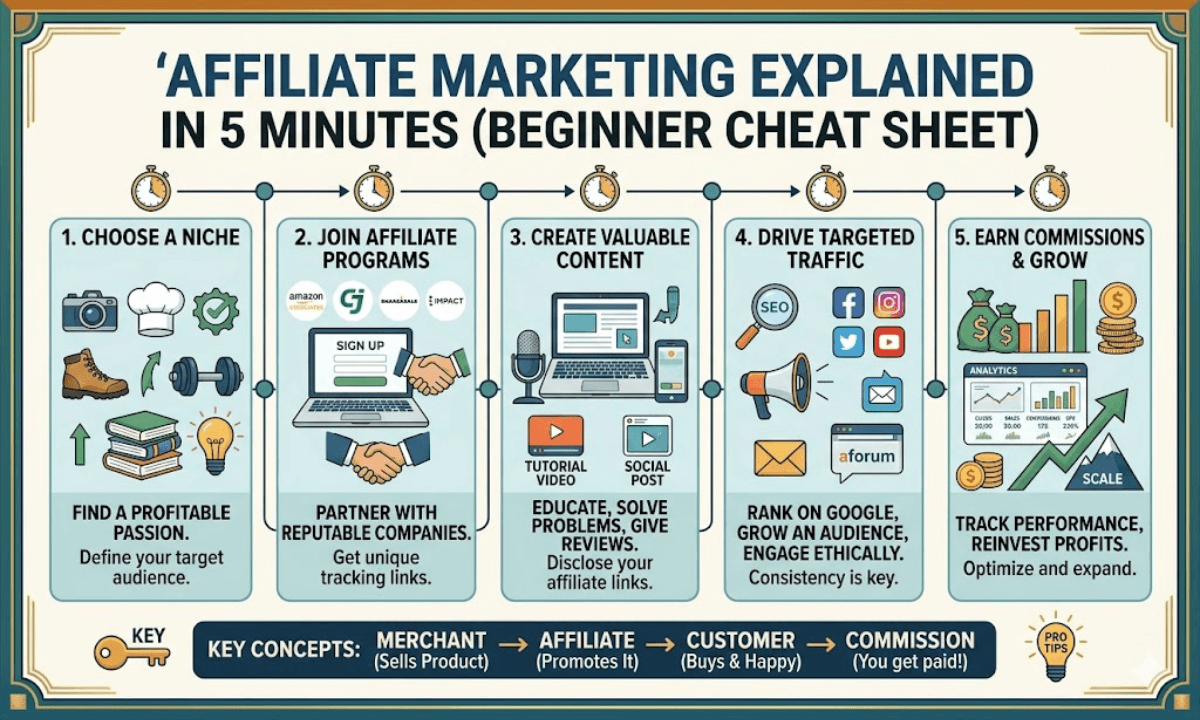
Affiliate Marketing Explained is one of the easiest ways for beginners to understand how people earn money online by promoting products and services. In this quick guide, you’ll learn how affiliate marketing works, how commissions are earned, and how to get started today.
Affiliate marketing is one of those topics buried under so much jargon, so many YouTube courses, and so many “guru” sales funnels that most beginners give up before they understand the basic concept.
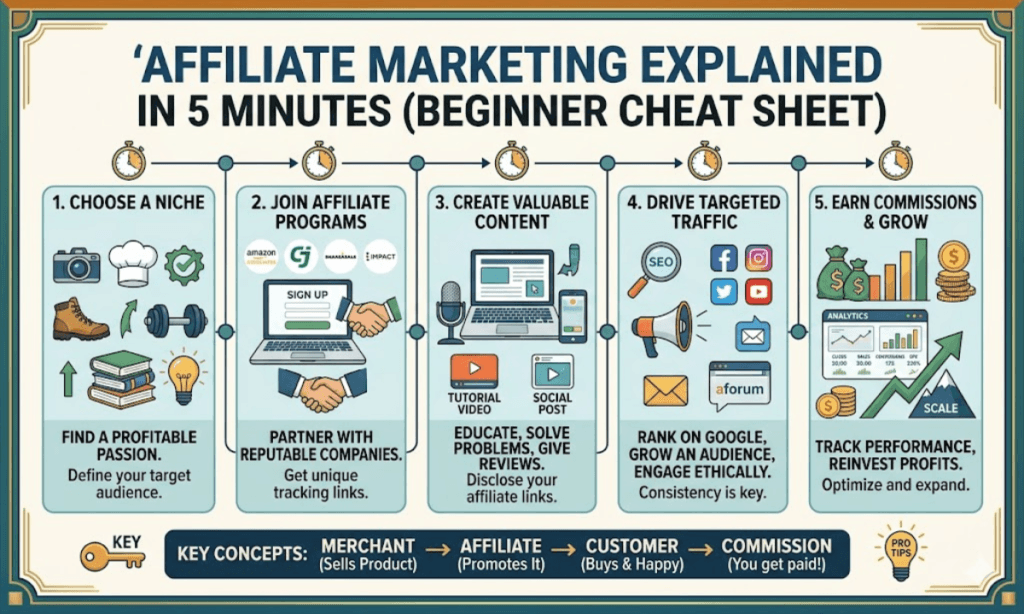
So here it is, plain and simple: you recommend a product, someone buys it through your link, and the company pays you a commission. That’s the entire model.
No inventory. No customer service. No product creation. No upfront cost to start.
This cheat sheet explains everything you actually need to know to begin — in plain language, without the 3-hour YouTube video or the $497 course that teaches the same thing.
The Core Concept in One Example
Imagine your friend asks you which web hosting company to use for their new blog. You recommend Hostinger because you’ve used it and it’s genuinely good. Your friend signs up using a link you shared.
Hostinger pays you $65 for that referral.
That’s affiliate marketing. The only difference between that conversation and professional affiliate marketing is that instead of one friend, you’re recommending to hundreds or thousands of people through a blog, a YouTube video, a TikTok, or an email newsletter.
How Affiliate Links Actually Work
Every affiliate program gives you a unique tracking link. When someone clicks your specific link and makes a purchase, the company’s system records that the sale came from you — and adds the commission to your account.
Here’s the technical process simplified:
- You join an affiliate program (free to join)
- You get a unique URL that looks like:
amazon.com/product?tag=yourname-20 - You share that URL in your content
- When someone clicks it, a tracking cookie is placed in their browser
- If they buy within the cookie window (usually 24–90 days), you earn a commission
- Commissions accumulate in your affiliate dashboard
- When you hit the minimum payout, the money transfers to your bank or PayPal
That’s the entire mechanics. Nothing complicated. Just a tracked link that pays you when it converts.
The 4 Things You Need to Start Earning Affiliate Commissions
You don’t need a massive audience or a professional website to start. But you do need these four things:
1. A Platform to Share Your Links
This is where your audience finds your recommendations. Options include:
- A blog — best for long-term passive income through Google search
- YouTube channel — links in descriptions get clicks for years
- TikTok or Instagram — fast audience growth, links in bio
- Pinterest — pins with affiliate links earn passively for months
- Email newsletter — highly engaged readers, excellent conversion rates
You don’t need all of these. You need one. Start where you’re most comfortable creating content.
2. A Niche (Specific Topic Area)
Affiliate marketing works best when you’re focused on a specific topic. “General lifestyle” is too broad. “Budget travel for solo female travelers” is a niche. “AI tools for freelance writers” is a niche.
A niche helps you:
- Attract an audience with specific buying intent
- Recommend genuinely relevant products
- Build authority that makes your recommendations trusted
3. Affiliate Programs to Join
You need affiliate programs before you can share links. Here’s where most beginners start:
- Amazon Associates — millions of products, 1–10% commission, easy approval
- ShareASale — hundreds of brands across every niche
- Impact.com — major brands, higher commissions
- CJ Affiliate — a large network with well-known retailers
- Individual brand programs — many SaaS companies have their own programs paying 20–50%
To find affiliate programs in your niche, Google: [your niche] + affiliate program. Almost every product category has one.
4. Consistent Content That Includes Your Links
This is the part most people underestimate. Affiliate income comes from traffic that consistently flows to content with affiliate links in it.
One article with affiliate links will earn sporadically. Ten articles earn more consistently. Fifty articles earn daily. The relationship between content volume and income is not complicated — more quality content with well-placed affiliate links equals more income.
The Most Common Affiliate Marketing Models
The Review Post
You write a detailed, honest review of a product. People searching “Is [product] worth it?” or “[product] review 2026” find your post. They trust your honest assessment and click your affiliate link.
Works best for: Software, hosting, courses, physical products, tools
Example: “Hostinger Review 2026: Is It Worth It for Beginner Bloggers?”
The Comparison Post
You compare two competing products side by side. People searching “[Product A] vs [Product B]” are ready to buy — they just need help deciding.
Works best for: Software, hosting plans, similar products in the same category
Example: “Bluehost vs Hostinger: Which Is Better for New Bloggers?”
The Best-Of List
You round up the top 5, 10, or 15 products in a specific category. High search volume, high buying intent, multiple affiliate links in one post.
Works best for: Any product category with multiple competing options
Example: “7 Best AI Writing Tools for Bloggers in 2026”
The Tutorial With Tool Recommendation
You teach someone how to do something, and naturally recommend the tool that makes it easier.
Works best for: Software tutorials, technical how-to guides, skill-based content
Example: “How to Start a Blog in 2026 (Step-by-Step)” — naturally recommends hosting
How Much Can You Actually Earn?
Honest answer: it varies enormously depending on your niche, traffic, and commission rates.
Here’s a realistic framework:
Low-commission niches (1–5% commission): Amazon Associates physical products — you need high traffic volume to earn well. A $100 product at 4% = $4 per sale. You need 100 sales/month to earn $400.
Mid-commission niches (10–30% commission): Online courses, software tools, digital products — better income per sale. A $50 course at 30% = $15 per sale. 100 sales/month = $1,500.
High-commission niches (40–70% commission): Premium SaaS tools, hosting, some digital programs — best income per sale. A $200/year SaaS at 50% = $100 per sale. 30 sales/month = $3,000.
Recurring commission niches: Some programs pay you every month that a referred customer remains subscribed. One referral who stays for 12 months pays you 12 commissions. These are the most powerful long-term affiliate models.
The Mistakes That Keep Beginners Earning Nothing
Promoting products they’ve never used. Readers can tell when a review is hollow. Authenticity is your competitive advantage — use the products you recommend.
Choosing only high-commission programs regardless of relevance. A $200 commission on a product nobody in your audience needs converts to $0. A $5 commission on a product 40% of your readers want converts to real income.
Not disclosing affiliate relationships. This is a legal requirement in most countries and a Google ranking factor. Always include a clear disclosure: “This post contains affiliate links. I may earn a commission if you buy through my links at no extra cost to you.”
Expecting results in the first month. Affiliate income builds with traffic, and traffic builds with time. Three months of consistent effort is the minimum before judging results.
Putting affiliate links before trust. If every piece of content feels like a sales pitch, readers leave and never come back. The ratio should be roughly 80% genuinely helpful content and 20% recommendations.
Your First Week in Affiliate Marketing
Here’s a simple 7-day start plan:
Day 1: Choose your niche and your primary platform
Day 2: Join 2–3 affiliate programs relevant to your niche
Day 3: Write your first piece of content (review, comparison, or list)
Day 4: Add your affiliate links naturally within the content
Day 5: Add affiliate disclosure to your site or profile
Day 6: Promote your first piece of content (Pinterest, social media, forums)
Day 7: Plan your next 3 pieces of content
That’s it. Week one complete. The income doesn’t come in week one — but the foundation does.

One Final Thing Most Guides Don’t Say
Affiliate marketing is not passive income from day one. It becomes passive income after you’ve built the content library and traffic source that make it work.
The passive part — earnings arriving while you sleep — is real. But it comes after weeks or months of active content creation and promotion.
Everyone who earns passive affiliate income today was in your position once. They just kept publishing and promoting past the point where most people stop.
Your cheat sheet is complete. Now it’s time to take the first step.
Share this with a friend who keeps saying affiliate marketing is “too complicated” — it’s a lot simpler than most people think.

Muse is the founder of MusabGuide, covering online business, digital marketing, and AI tools. He creates practical guides and honest reviews to help beginners and entrepreneurs make informed decisions online.
2 thoughts on “Affiliate Marketing Explained in 5 Minutes (Beginner Cheat Sheet)”