
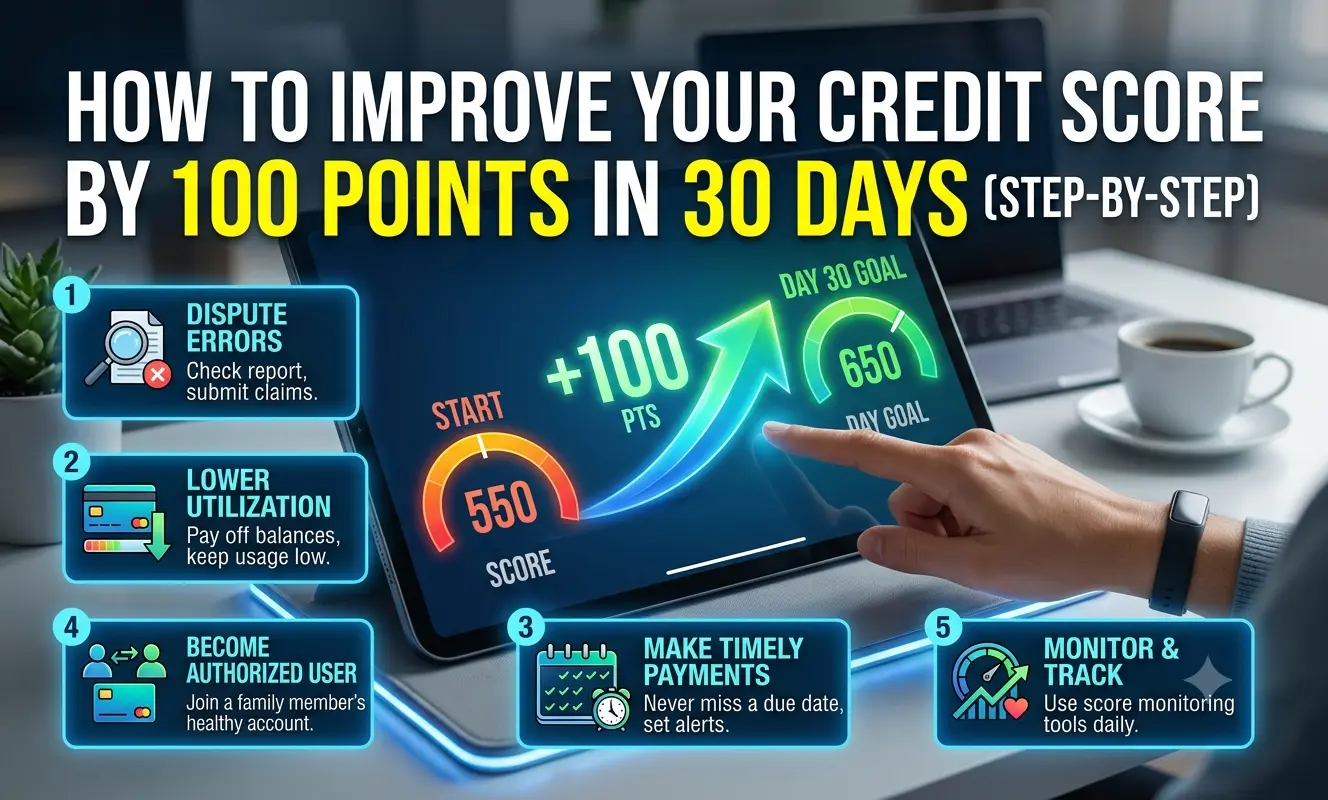
If you’re wondering how to improve your credit score, you’re not alone. A higher credit score can help you qualify for better loans, lower interest rates, and more favorable financial opportunities. While increasing your score by 100 points in just 30 days isn’t guaranteed for everyone, the right strategies can make a significant difference. In this step-by-step guide, you’ll learn practical, proven methods to quickly improve your credit score, avoid common mistakes, and build stronger financial health for the future.
If you want to improve your credit score by 100 points in 30 days, the strategies you’re about to learn are the same ones used by credit counselors, financial advisors, and consumers who’ve successfully moved from fair credit to excellent credit — sometimes faster than they thought possible.
The difference between a 620 and a 720 credit score isn’t just a number on a report. It can mean saving over $50,000 in interest on a 30-year mortgage. It can be the difference between approval and rejection for a car loan. It can lower your insurance premiums, get you a better apartment, and even affect whether you qualify for certain jobs.
Here’s the good news: raising your credit score by 100 points is not a fantasy. It is a project — one that requires understanding what’s hurting your score, applying the right strategies in the right order, and staying consistent long enough to see compounding results. And some strategies can start showing results within 30 days.
This guide breaks down every proven method, ranked by real-world impact. No filler. No vague advice. Just the exact playbook that works for people with fair or poor credit who want to improve their financial life quickly.

Why Your Credit Score Matters More Than Ever in 2026
Your credit score is one of the most powerful numbers in your financial life. With mortgage rates elevated and personal loan costs rising in 2026, the difference between fair credit (620) and good credit (720) can save you tens of thousands of dollars over the life of your loans.
Both FICO and VantageScore — the two most widely used credit scoring models — operate on a scale from 300 to 850. Here’s how the ranges break down:
- 300–579: Poor
- 580–669: Fair
- 670–739: Good
- 740–799: Very Good
- 800–850: Exceptional
If you’re currently in the “poor” or “fair” range, moving into “good” territory unlocks better interest rates, higher approval odds, and dramatically better financial flexibility. This is why learning how to improve your credit score quickly matters — the sooner you fix your score, the sooner you stop losing money to high interest rates.
Understanding What Actually Affects Your Credit Score
Before applying any strategy, you need to understand what actually moves your score. FICO groups credit report information into five weighted categories:
- Payment History — 35%
- Amounts Owed / Credit Utilization — 30%
- Length of Credit History — 15%
- New Credit / Inquiries — 10%
- Credit Mix — 10%
For fast improvement, the top two categories are where 90% of the movement happens. Payment history and credit utilization together account for 65% of your score — meaning if you focus your energy here, you’ll see the biggest changes in the shortest time.
The other three factors — credit history length, new credit inquiries, and credit mix — matter, but they rarely change fast. Don’t waste your first 30 days worrying about them.
Step 1 — Pull Your Free Credit Report Today
You can’t fix what you can’t see. Before doing anything else, get your free credit reports from all three major bureaus.
Where to get them (free):
- AnnualCreditReport.com — the only federally authorized site for free reports
- You’re entitled to one free report from each bureau every week under current federal rules
Pull reports from all three bureaus at once:
- Equifax
- Experian
- TransUnion
Read every line carefully. Look for:
- Accounts you don’t recognize
- Late payments that were actually paid on time
- Incorrect balances
- Duplicate accounts
- Accounts belonging to someone with a similar name
- Old collections that should have been removed
According to the Federal Trade Commission’s research, one in five consumers has a verified error on at least one credit report. If you find one, disputing it successfully could increase your score by 20 to 50 points within 30 to 45 days.
Step 2 — Dispute Errors on Your Credit Report
Disputing errors is the single highest-leverage action you can take to improveyour credit score quickly if errors exist on your report.
How to Dispute an Error:
- Go directly to the bureau’s website (Equifax.com, Experian.com, or TransUnion.com)
- Submit a dispute online with documentation supporting your case
- The bureau is legally required to investigate within 30 days
- Incorrect information must be corrected or removed
Pro Tip That Most Guides Miss:
If the bureau doesn’t resolve the dispute in your favor, dispute directly with the data furnisher — the creditor reporting the incorrect information. Under the Fair Credit Reporting Act (FCRA), they are legally required to investigate. This often produces better results than disputing only through the bureau.
Successful disputes have been shown to produce an average score increase of 25 points, with some cases exceeding 100 points when erroneous collections or late payments are removed.
Step 3 — Master the Credit Utilization Trick
Credit utilization — the percentage of your available credit that you’re currently using — accounts for 30% of your FICO score. This is the fastest-moving factor you can control.
The Numbers That Matter:
- Below 10% utilization — Optimal, associated with the highest scores
- 10%–30% utilization — Good, minimal negative impact
- 30%–50% utilization — Moderate negative impact
- 50%+ utilization — Significant negative impact
- 75%+ utilization — Severe negative impact
The Utilization Sweet Spot
For maximum score improvement, aim to have your reported utilization between 1% and 9% on each card AND across all cards combined. This is the range associated with the best possible credit scores.
Here’s a real example:
- Card A: $2,000 balance / $5,000 limit = 40% utilization
- Card B: $500 balance / $2,000 limit = 25% utilization
- Card C: $0 balance / $3,000 limit = 0% utilization
- Total: $2,500 / $10,000 = 25% overall utilization
Paying Card A down to $500 immediately changes the picture:
- Card A: $500 / $5,000 = 10% ✅
- Total: $1,000 / $10,000 = 10% utilization
That single move can boost a fair credit score by 20–40 points within one billing cycle.
Step 4 — Use the 15/3 Payment Rule
This is one of the most powerful hacks to raise a credit score quickly, and most people have never heard of it.
How the 15/3 Rule Works:
Credit card issuers report your balance to the credit bureaus once per month — usually right after your statement closing date. If your balance is high when they report, that high utilization gets recorded, even if you pay it off two days later.
The 15/3 rule beats this timing problem:
- 15 days before your statement closing date — pay half your credit card balance
- 3 days before your statement closing date — pay the remaining balance (or a large portion)
Example:
- Statement closes on the 30th of each month
- On the 15th, pay $1,000 of your $2,000 balance
- On the 27th, pay another $800
- Your reported balance is only $200 — a dramatic utilization drop
This alone can boost your credit score by 15–40 points within one reporting cycle without adding a single dollar to your debt.
Step 5 — Request Credit Limit Increases
A higher credit limit with the same spending immediately lowers your utilization ratio. This is one of the cleanest ways to chase a large score move in a short window.
How to Do It Right:
- Log in to your credit card account online
- Look for “Credit Limit Increase” in the account settings
- Many issuers grant modest increases (say, from $3,000 to $5,000) with just a soft inquiry
- Ask for a 30–50% increase — not too aggressive
Important: A soft inquiry does not affect your score. A hard inquiry drops your score by a few points temporarily. Always ask the issuer if the review requires a hard pull before proceeding.
The Math That Matters:
If your income has grown or your credit profile has improved since you opened a card, this move is nearly a guaranteed win. A $3,500 balance on a $5,000 limit is 70% utilization. That same $3,500 balance on an $8,000 limit is only 44%. On a $10,000 limit, it drops to 35%. Getting limit increases across multiple cards compounds this effect significantly.
Step 6 — Become an Authorized User on a Trusted Account
When someone adds you as an authorized user on their credit card, that card’s entire history — payment record, age, and utilization — typically appears on your credit report. If the primary cardholder has a long, clean payment history and low utilization, you inherit those positive signals.
The Ideal Authorized User Account Has:
- Age: 5+ years old (boosts your average account age)
- Payment history: 100% on-time (no late marks ever)
- Utilization: Under 10%
- Issuer: Confirms they report authorized users to all three bureaus
Why It Works So Fast:
Authorized user accounts have been shown to add an average of 22 points to thin-file consumers’ scores within the first reporting cycle. If you can be added to a family member’s or trusted friend’s account with strong credit, you get an instant boost.
You don’t need physical access to the card. You don’t need to make any charges. You just need the account to appear on your credit report — and the payment history and utilization to be favorable.
Step 7 — Sign Up for Experian Boost (Free)
Experian Boost is a free tool that adds on-time utility bills, phone bills, streaming services, and now rent payments to your Experian credit file. These are expenses you’re already paying that typically don’t appear on your credit report.
How to Get It:
- Go to Experian.com/Boost
- Connect your bank account
- Verify the utility, phone, or streaming payments you want counted
- See your Experian FICO score update instantly
Some users see immediate score jumps of 10–20 points. It’s genuinely free, takes 10 minutes, and adds no risk since you can remove any account at any time.
Note: Boost only affects your Experian-based scores. Lenders using Equifax or TransUnion scores may not see the benefit. Still, given zero cost and zero risk, this is a no-brainer step.
Step 8 — Set Up Autopay on Every Account
Payment history is 35% of your credit score — the biggest single factor. A single late payment (30+ days past due) can drop your score by 60–110 points and remain on your report for 7 years.
The best way to guarantee this never happens is autopay.
The Setup Rules:
- Set autopay for at least the minimum payment on every credit account
- Ideally, autopay the full statement balance to avoid interest charges
- Confirm your bank account has enough money to prevent overdrafts
- Check every 3 months that autopay is still active
This single step protects the largest factor in your credit score from the human error that damages millions of scores every year.
Step 9 — Handle Collections the Right Way
Collection accounts are score killers. Under FICO 8, a single collection — even a paid one — can suppress your score by 50 to 100 points. But here’s what most people don’t know: newer scoring models (FICO 9, FICO 10, and VantageScore 4.0) ignore paid collections entirely.
If You Have Collections:
- Don’t pay them randomly — a paid collection can still hurt older scoring models
- Negotiate a “pay for delete” — offer to pay in exchange for removal from your credit report
- Get any agreement in writing before paying
- Send the payment via certified mail with proof of delivery
- Wait 60 days — then check your credit report to confirm removal
Not all collections agencies will agree to pay-for-delete, but many will — especially for older, smaller accounts they’ve nearly given up collecting on.
If pay-for-delete isn’t possible, your next best move is to focus on the other strategies in this guide. Time will eventually reduce the impact of collections on your score.

Common Mistakes That Kill Your Progress
Even with good strategies, these mistakes will slow or completely stop your credit score improvement.
Closing Old Credit Cards
Closing a credit card immediately reduces your total available credit, which can increase your credit utilization rate and hurt your scores. The length of credit history also makes up 15% of your FICO score.
If you no longer need a card, put a small recurring bill on it (like a $10 streaming subscription) and set up autopay for the full balance. This keeps the account active without any effort.
Applying for Multiple New Credit Cards
Every hard inquiry drops your score by a few points. Applying for 3–4 new cards in a month can drop your score by 15–25 points at exactly the moment you’re trying to raise it.
Wait 6 months between credit applications when you’re actively trying to improve your credit score.
Paying a Card to Zero and Running Balance Back Up
The score bump from paying a card down fades if the balance climbs back up next month. Fast wins come from lower balances that stay low.
Ignoring the Statement Date
Most people time payments around the due date. But the balance that gets reported to the credit bureaus is your statement balance — which is different. Pay before your statement closes, not before the due date.
What to Expect Week by Week
Here’s a realistic timeline of what happens when you execute this plan:
Week 1
- Credit reports pulled from all three bureaus
- Errors identified and disputes submitted
- Experian Boost activated
- Autopay is set up on all accounts
- Credit limit increase requests submitted
Week 2
- First credit limit increases approved (soft-pull cards)
- Experian Boost points added
- Utilization payments made per the 15/3 rule
- Authorized user status added if arranged
Week 3
- Credit card statements close, reporting new lower utilization
- First score movement visible in credit monitoring apps
Week 4 (End of 30 Days)
- Dispute results returning from bureaus
- The second round of utilization payments was made
- Realistic score movement: 30–80 points, depending onthe starting point and how many strategies were executed successfully
Hitting 100 points of improvement in 30 days is possible for consumers with clear fixable issues — verified errors, high utilization, or thin files that benefit dramatically from authorized user status. For consumers with accurate major negatives (recent missed payments, active collections), the same 100-point movement typically takes 90–180 days.
Frequently Asked Questions
How much can I realistically improve my credit score in 30 days?
For consumers with fixable issues — high credit utilization, errors on their credit report, or thin credit files — improvements of 40–100 points in 30 days are realistic. For consumers with accurate negatives (like recent late payments or active collections), 15–40 points in the first 30 days are more realistic, with larger gains over 3–6 months.
What’s the fastest way to improve a credit score?
The single fastest strategy is reducing your credit utilization ratio. Because credit card issuers report to bureaus monthly, paying down a high balance can produce visible score improvement within one billing cycle — often 15–40 points in 30 days.
Does checking my own credit hurt my score?
No. Checking your own credit is a “soft inquiry” and has zero impact on your score. You can check as often as you want. Hard inquiries come only from lender applications for new credit.
Should I pay off collections to improve my credit score?
It depends. Under newer scoring models (FICO 9, FICO 10, VantageScore 4.0), paid collections are ignored. Under the older FICO 8 (still widely used), paid collections still hurt. Your best move is to negotiate a “pay for delete” agreement in writing before paying anything to a collection agency.
Does the 15/3 rule really work?
Yes. The 15/3 rule works because it lowers the balance that gets reported to credit bureaus. Credit card issuers typically report your balance once per month, around your statement closing date. Paying twice — 15 days before and 3 days before — ensures a low balance gets reported, which lowers your utilization ratio.
How often is my credit score updated?
Credit scores typically update once per month when creditors report data to the credit bureaus. This is why timing your payments around statement dates matters more than most people realize.
Should I close credit cards I don’t use?
Generally, no. Closing a credit card immediately reduces your total available credit and can hurt your credit utilization ratio. Keep old cards open — put a small recurring charge on them and set up autopay to keep them active without effort.
Can I improve my credit score without a credit card?
Yes, but more slowly. Options include becoming an authorized user on someone else’s card, opening a credit-builder loan, using a secured credit card, or signing up for services like Experian Boost that count utility and rent payments toward your credit file.

Final Thoughts and Next Steps
Learning how to improve your credit score by 100 points isn’t magic. It’s a series of specific actions applied in the right order — most of which can be done in a single afternoon.
The consumers who succeed at this aren’t smarter or luckier than anyone else. They simply take the actions that most people never take: they pull their credit reports, they dispute errors, they call their card issuers, they time their payments strategically, and they treat their credit score like a financial project rather than a mystery.
You now have every step in the exact order. What matters next is execution.
Your Action Plan for This Week:
- Today: Pull your free credit reports from AnnualCreditReport.com
- Tomorrow: File disputes for any errors you find
- Day 3: Sign up for Experian Boost
- Day 4: Request credit limit increases on all your cards
- Day 5: Set up autopay on every credit account
- Day 7: Ask a trusted family member about being added as an authorized user
Do these seven actions in the next week, and by day 30 your score will almost certainly be higher — possibly dramatically so.
The next 30 days can genuinely change the trajectory of your financial life. Every point you add to your credit score is money you’ll save on every loan, mortgage, and credit product you use for the rest of your life.
Start today.
Suggested Internal Link Opportunities
- “How to Start Investing With $100 in 2026” — link from the financial foundation section
- “7 Passive Income Streams That Pay You While You Sleep” — link from wealth-building section
- “How to Build a Daily Online Income” — link from income improvement context
Suggested External Authority Sources
- AnnualCreditReport.com (official free credit report site)
- Consumer Financial Protection Bureau (CFPB.gov)
- Federal Trade Commission Consumer Advice (Consumer.FTC.gov)
- Experian, Equifax, and TransUnion official sites
Financial Disclaimer to Add at the End
This article is for informational and educational purposes only and does not constitute financial or credit advice. Individual results may vary based on your specific credit situation. Always consult a certified credit counselor or financial advisor for advice tailored to your situation.
How to Improve Your Credit Score by 100 Points in 30 Days (Step-by-Step Guide)
How to Improve Your Credit Score by 100 Points in 30 Days (Step-by-Step Guide)
How to Improve Your Credit Score by 100 Points in 30 Days (Step-by-Step Guide)
How to Improve Your Credit Score by 100 Points in 30 Days (Step-by-Step Guide)
How to Improve Your Credit Score by 100 Points in 30 Days (Step-by-Step Guide)
How to Improve Your Credit Score by 100 Points in 30 Days (Step-by-Step Guide)
How to Improve Your Credit Score by 100 Points in 30 Days (Step-by-Step Guide)
How to Improve Your Credit Score by 100 Points in 30 Days (Step-by-Step Guide)
How to Improve Your Credit Score by 100 Points in 30 Days (Step-by-Step Guide)
How to Improve Your Credit Score by 100 Points in 30 Days (Step-by-Step Guide)
How to Improve Your Credit Score by 100 Points in 30 Days (Step-by-Step Guide)
How to Improve Your Credit Score by 100 Points in 30 Days (Step-by-Step Guide)
How to Improve Your Credit Score by 100 Points in 30 Days (Step-by-Step Guide)
How to Improve Your Credit Score by 100 Points in 30 Days (Step-by-Step Guide)
How to Improve Your Credit Score by 100 Points in 30 Days (Step-by-Step Guide)
How to Improve Your Credit Score by 100 Points in 30 Days (Step-by-Step Guide)
How to Improve Your Credit Score by 100 Points in 30 Days (Step-by-Step Guide)
How to Improve Your Credit Score by 100 Points in 30 Days (Step-by-Step Guide)
How to Improve Your Credit Score by 100 Points in 30 Days (Step-by-Step Guide)
How to Improve Your Credit Score by 100 Points in 30 Days (Step-by-Step Guide)
How to Improve Your Credit Score by 100 Points in 30 Days (Step-by-Step Guide)
How to Improve Your Credit Score by 100 Points in 30 Days (Step-by-Step Guide)
How to Improve Your Credit Score by 100 Points in 30 Days (Step-by-Step Guide)
How to Improve Your Credit Score by 100 Points in 30 Days (Step-by-Step Guide)
How to Improve Your Credit Score by 100 Points in 30 Days (Step-by-Step Guide)
How to Improve Your Credit Score by 100 Points in 30 Days (Step-by-Step Guide)
How to Improve Your Credit Score by 100 Points in 30 Days (Step-by-Step Guide)
How to Improve Your Credit Score by 100 Points in 30 Days (Step-by-Step Guide)
How to Improve Your Credit Score by 100 Points in 30 Days (Step-by-Step Guide)
How to Improve Your Credit Score by 100 Points in 30 Days (Step-by-Step Guide)
How to Improve Your Credit Score by 100 Points in 30 Days (Step-by-Step Guide)
How to Improve Your Credit Score by 100 Points in 30 Days (Step-by-Step Guide)
How to Improve Your Credit Score by 100 Points in 30 Days (Step-by-Step Guide)
How to Improve Your Credit Score by 100 Points in 30 Days (Step-by-Step Guide)
How to Improve Your Credit Score by 100 Points in 30 Days (Step-by-Step Guide)
How to Improve Your Credit Score by 100 Points in 30 Days (Step-by-Step Guide)
How to Improve Your Credit Score by 100 Points in 30 Days (Step-by-Step Guide)
How to Improve Your Credit Score by 100 Points in 30 Days (Step-by-Step Guide)

Muse is the founder of MusabGuide, covering online business, digital marketing, and AI tools. He creates practical guides and honest reviews to help beginners and entrepreneurs make informed decisions online.